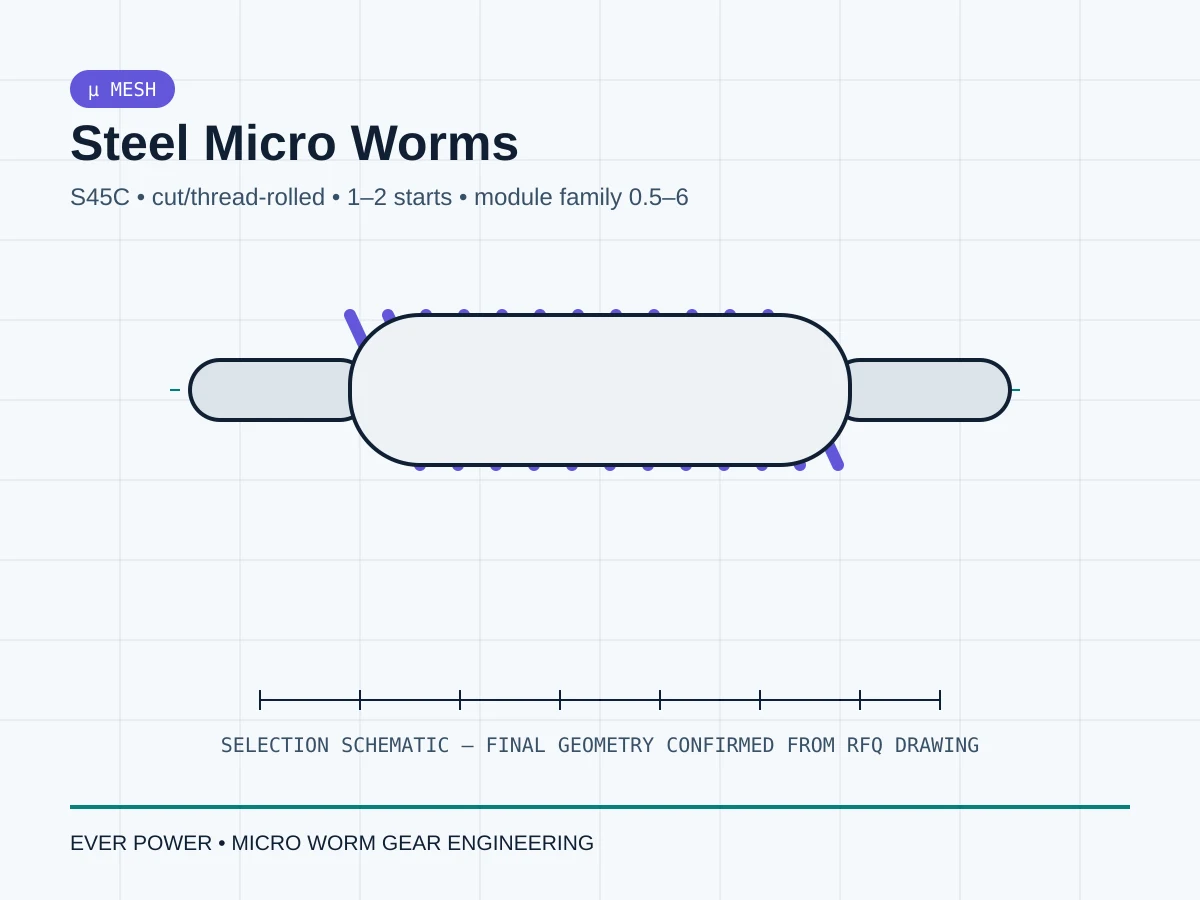
Descrição
Engineering scope
This is the practical starting point for mechanisms that need a small steel worm without the added process of a ground, induction-hardened tooth surface. Selection still depends on duty cycle, lubrication, ratio and the chosen wheel material.
The values below describe a verified reference family or, for custom work, the information that must be defined before production. They are selection boundaries rather than a promise that every combination is stocked. EVER POWER confirms the final drawing, mating pair and manufacturing route at quotation stage.
Reference family parameters
| Selection field | Reference family / RFQ basis |
|---|---|
| Reference module family | 0.5–6 |
| Number of starts | 1–2 |
| Material family | S45C |
| Heat treatment | None in reference family |
| Tooth finish | Cut / thread-rolled |
| Reference precision family | Grade 4 |
| Typical mating families | Bronze or fine-pitch polymer worm wheels |
Important: do not select a worm and wheel independently by module alone. The number of starts, helix hand, ratio, center distance, tooth system and mounting geometry must form a compatible pair.
Where this product family is used
Micro worm gearing is useful when a designer needs right-angle power transmission and substantial reduction in a compact envelope. Typical project contexts for this family include:
- small manual adjustments
- motor-driven reduction stages
- compact indexing mechanisms
- light industrial equipment
Application examples describe common engineering contexts, not certified suitability. Load, speed, duty, lubricant, temperature and safety requirements remain project inputs.
Customization and drawing review
For a useful quotation, identify the items that control the interface and mesh. We can review:
- module, starts and helix hand
- bore or integral shaft arrangement
- mounting face and hub geometry
- blackening or project-specific surface finish
- wheel material pairing
- runout, backlash and inspection targets
When a mating component already exists, provide its drawing or a controlled sample. For replacement work, include rotation direction, installed center distance and photos of the original mesh if available.
Inspection and RFQ checklist
Geometry
- module or pitch system
- worm starts and hand
- wheel tooth count / target ratio
- center distance
- shaft, bore and hub dimensions
Operating data
- input speed and expected output torque
- duty cycle and reversing frequency
- lubrication method
- temperature and environment
- required quantity and destination
Selection trade-offs
A small worm pair should be selected as a system. Increasing reduction, reducing envelope, changing the number of starts, tightening backlash or switching wheel material can alter contact conditions, bearing reactions, heat generation and manufacturability at the same time. A practical RFQ therefore includes the target function and the fixed mechanical constraints rather than specifying one catalogue field in isolation.
When space is very limited, protect the dimensions that locate the mesh first: shaft axes, bearing seats, wheel bore/hub datum and center distance. Non-functional outside profiles can usually be discussed later. When accuracy matters, define the error that is visible at the mechanism output so the tooth and mounting tolerances can be allocated intelligently.
Manufacturing and quality planning
Production planning depends on material availability, turning or bore preparation, tooth generation, any heat-treatment operation, final finishing and inspection. A ground worm family has a different route from a cut worm, while bronze and polymer wheels use different material and machining controls. The quotation will identify the proposed route after the drawing and quantity are reviewed.
For samples, record any assembly adjustment made during the trial. If shims, bearing preload, lubrication or mating-part position were changed to make the sample work, update the released assembly condition before repeat production. For recurring orders, identify the characteristics that need batch records so inspection effort remains consistent and useful.
Frequently asked engineering questions
Can I order only the worm or only the wheel?
Yes, but the existing mating member still needs to be identified. Share its drawing, module/pitch system, starts or tooth count, hand and installed center distance so compatibility can be checked.
Can you quote from a worn sample?
A sample helps, but wear can distort tooth thickness and outside dimensions. Housing dimensions, an unworn mating part or the original drawing improves reverse-engineering confidence.
Can a micro worm pair be treated as self-locking?
No general catalogue statement should be used as a safety assumption. Backdriving depends on geometry, friction, lubrication, load, vibration and wear. Use a validated holding method when reverse motion must be prevented.